Signal by ERA: Designing Emergency Medical Response for Africa
A mobile-first emergency request system that connects patients to life-saving care in under 10 minutes.

Role
Product Designer (End-to-End)
Duration
3 months
Industry
Emergency & Healthcare
Every minute counts in a medical emergency. Yet across Nigeria, and Africa broadly, emergency victims routinely face rough transport, no medical attention in transit, and rejection at hospitals due to limited capacity, wrong specialties, or payment barriers.
"Signal" by ERA is Africa's mobile platform that changes this. One button press pinpoints your location, alerts the ERA command center, and dispatches the nearest verified First responder, all within minutes. Emergency contacts are notified automatically. You are never alone in a crisis.
I reached out to ERA and volunteered to design the system, contributing to their mission of delivering emergency medical care to every African in 10 minutes or less.
The Problem
Emergency victims in Nigeria had no reliable digital tool to request help, track response status, or notify loved ones — all at once, under stress, in seconds.
The gap wasn't just a product gap. It was a life-or-death infrastructure gap.
My Role
I owned the end-to-end product design for the Signal app, from discovery through final handoff. ERA had already established its brand identity, so my scope was focused on system design, UX flow, interaction design, and final UI.
Key collaborators: product manager (feature prioritization), ERA stakeholders (requirements), and a team of first responders who informed real-world scenarios.


Competitive Analysis
No existing product in the African market fully covers emergency help requests as required by ERA. I studied international emergency apps and related services—mapping their request flows, onboarding patterns, location-sharing mechanics, and triage processes to identify what worked and what didn't in an African context.
Key Insight: Most global apps assume reliable internet, high digital literacy, and existing insurance infrastructure. ERA's users needed a system that worked under stress, on low-end devices, with minimal taps.
Defining the User Flow
Working from competitive analysis findings, stakeholder requirements, and PM-prioritized features, I developed a user flow built around one principle: minimize cognitive load during a crisis.
The result was a short, purposeful sequence — fewer steps than any comparable international app designed for users who may be panicked, injured, or acting on behalf of someone else.
The user flow was developed with a clear understanding of the current status of the healthcare space, defined requirements by the stakeholders, feature prioritization by the product manager, and a clearly defined goal.
Having developed the right persona for different scenarios when it comes to medical emergency requests, we were able to come up with a series of short but purposeful steps required to request a medical emergency.
Wireframing
I generated multiple low-fidelity concepts before aligning with stakeholders on a primary direction. Key considerations included the following:
Stress state design — large tap targets, high contrast, minimal reading required
African context — variable network conditions, feature phone legacy expectations, multi-scenario use (self-request vs. third-party request)
Trust signals — confirming help is on the way without overwhelming the user with information
This was an interesting process for me because I had to really consider so many factors, like the specific users we were creating the product for, which is Africa, their familiarity with this kind of service, several scenarios that they could be in while requesting the emergency care, etc.
Several concepts were explored and discarded before committing to the final direction.
Final Designs
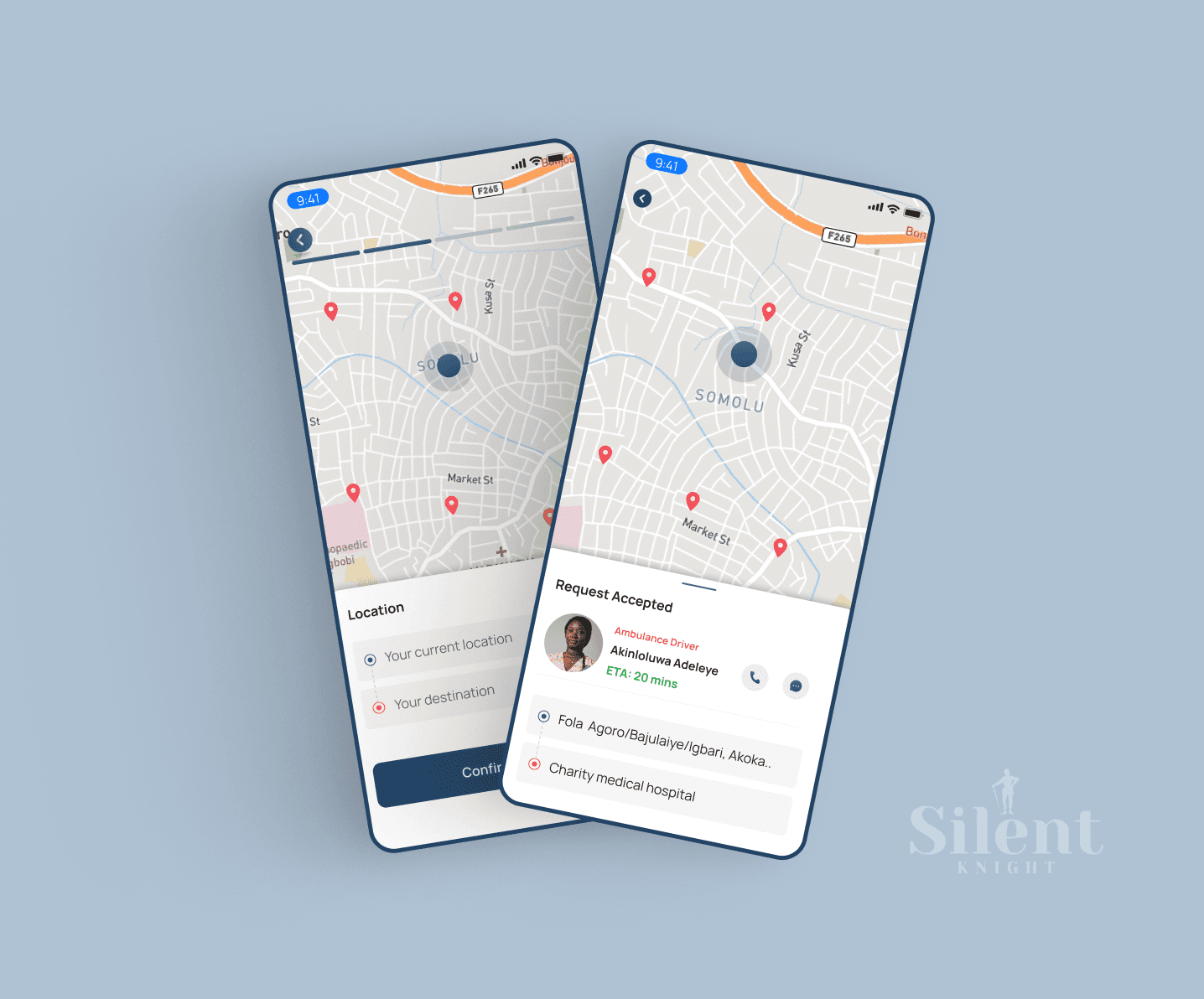
The final designs translated the agreed flow into a clean, high-contrast UI aligned with ERA's brand. Key screens included: emergency request initiation, real-time responder tracking, emergency contact notification, and hospital arrival status.
Since the initial launch, the product has continued to iterate, expanding to serve additional user groups and scenarios across Nigeria.


Outcomes
Metrics | Result |
|---|---|
User interest growth post-launch | 30–40% increase in Nigeria |
Strategic partnerships secured | Multiple (unexpected at launch) |
Time to responder dispatch | Reduced by 10 minutes post-launch |
Time to reflect.
So these were my learnings working on this project.
It was my first time working on a product in the healthcare space. There were a lot of things new to me about the space, and the knowledge I needed to go after to really understand how things worked there.
I love making multiple iterations before finalizing designs. I got a chance to explore a lot, but was also limited due to the uniqueness of the importance of the service to that sector.
It was fun working with the entire team, but most importantly, the guidance of the product manager, prioritizing the product features, made the proud launch a success.
What I Learned
Working in a high-stakes healthcare context taught me that the best emergency UX is the one users don't have to think about. Every design decision, from button size to notification copy, carried real human weight.
The experience also reinforced the value of cross-functional alignment early. The PM's feature prioritization kept the product focused and shippable without compromising the core value proposition.
